
Between floods, droughts, and wildfires, the Bay Area has broken virtually every climate-related record over the past decade. The Bay Area Council’s Climate Resilience Committee advocates for innovative policy solutions to make the Bay Area the most climate-resilient coastal region in the world.
Key Priorities
Flood Protection
- Streamline permitting for coastal resilience projects. In 2026, the Bay Area Council sponsored AB 2051 (Wicks), which calls for a coastal resilience permitting roadmap to address barriers for critical resilience projects along the shoreline. The legislation was signed by the Governor, and lawmakers must now fund relevant agencies to begin implementation.
- Federal funding for the USACE general investigation study. Major federal investments to bolster coastal flood defenses in the San Francisco Bay must be preceded by a general investigation study by the U.S. Army Corps of Engineers. President Biden authorized this study just prior to leaving office, but it is not yet funded. The Council will build a coalition of businesses, in tandem with the Council’s annual DC trip, to lobby the Trump Administration and California Congressional Caucus to fund the study.
- Measure AA renewal. In 2016, the Bay Area Council co-chaired the Bay Area’s first nine-county ballot initiative, Measure AA, a flat $12 parcel tax to fund wetland restoration and flood protection projects along the Bay Shoreline. With Measure AA funding delivering on its campaign promises, the Bay Area Council and its partners are strategizing ways to renew the measure.
Drought Resilience
- Streamline permitting for major water supply projects. Existing law requires California to create 9-million-acre feet of new water by 2040. However, California cannot meet this goal under the current lengthy permitting timelines for water projects, which also add tens of millions of dollars in avoidable costs, hurting water affordability. California should create a consolidated permitting pathway for the types of large water storage, recycling, and desalination projects needed to accomplish state goals on time.
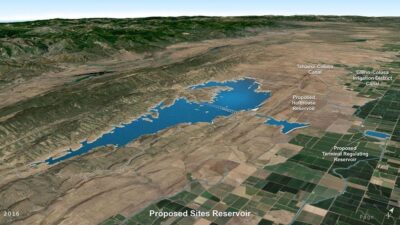
- Complete Sites Reservoir. Sites Reservoir is critical to the long-term water security of the Bay Area and other regions in California, especially following the collapse of the Los Vaqueros Reservoir Expansion project. The Bay Area Council supports the State Water Resources Control Board’s revised water rights decision and encourages a speedy groundbreaking.
- Support Delta Conveyance Project. About half of all Bay Area homes receive water that passes through the Sacramento-San Joaquin River Delta. However, this critical water resource is vulnerable to catastrophic seismic failure and to long-term decline from salinity intrusion. The Bay Area Council supports the Delta Conveyance Project as an urgent climate and seismic adaptation measure.
- Analyze impacts of environmental regulations on water affordability and housing production. The State Water Resources Control has enormous power to dictate how much water must be left in rivers and streams irrespective of state housing goals or affordability impacts on ratepayers. State agencies and the public deserve a more comprehensive understanding of the impacts of new regulatory decisions before they are adopted.
- Support water data improvements: In 2016, the Bay Area Council sponsored AB 1755 (Dodd) to modernize California’s antiquated water data system. Better data means improved management, better regulatory decision making, and stronger transfer markets. The Bay Area Council has a seat on the Board of the California Water Data Consortium and advocates for stronger water data protections.
California Resilience Challenge
A philanthropic initiative of the Bay Area Council Foundation, the California Resilience Challenge was launched in 2019 to develop a pipeline of early-stage climate adaptation planning projects to strengthen local resilience in under-resourced communities across California against floods, drought, wildfires, and extreme heat. Working in partnership with major employers, utilities and nonprofit organizations, the Resilience Challenge enjoyed remarkable success over its six years of operation, providing 38 innovative projects with $6 million in grants that were leveraged to raise an additional $73 million (and counting), including $40 million for implementation. Learn more about the California Resilience Challenge.