
What the 2025 Homeless Report Says about California
The annual homeless estimate for 2025 was finally (if partially) released by the U.S. Department of Housing and Urban Development last week (May 2026) following months of delay. The report contains estimates of homelessness in every state plus D.C. on a single night in January 2025 and is used to plan the federal Continuum of Care Program, the primary anti-homelessness program in the nation. The detailed reports by state, continuums of care, and housing inventory counts, have not yet been released. Now that that’s out of the way, let’s look at what can be gleaned from what was released and how this pertains to Bay Area Council policy advocacy.
Unsheltered homelessness in California is down 7 percent, the first decline since 2014. While any decline in California’s unsheltered population is good news, it’s still too early to say if this is an anomaly or the beginning of a trend: California’s unsheltered population is still 2 percent larger than it was in January 2020, and its total homeless population 13 percent larger. For comparison, Florida reduced its unsheltered population by 22 percent during the same period despite unsheltered homelessness being rarer overall in the state. Texas reduced its unsheltered population by 1 percent, and New York’s increased 4 percent.

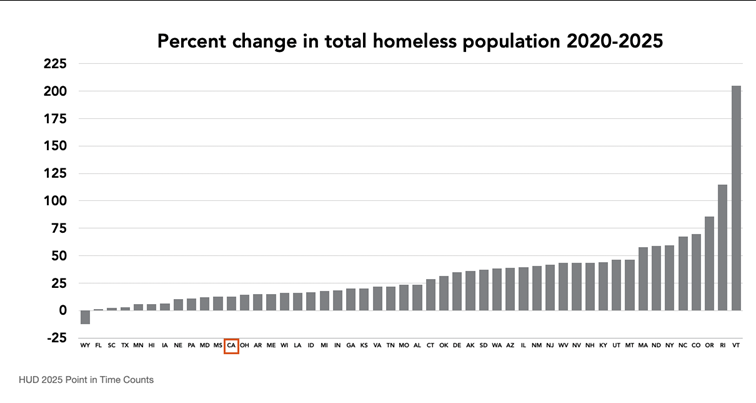
Homelessness in California overall is down 3 percent, the first decline since 2018. However, the state’s homeless population remains up 13 percent since 2020, so it’s unclear if this is an anomaly or the start of a longer shift. One thing that could help us find out is to compare California to national trends over a few years, and there it seems like yes, there may be a broader shift underway.

Homelessness has grown much more slowly in California since 2020 than most other states. California’s 13 percent increase in homelessness since 2020 looks a lot better when you consider that homelessness increased a whopping 35 percent across the other 49 states (removing California) since 2020, with the biggest per capita jumps coming from unexpected places like Vermont (+205%), Rhode Island (115%), and Utah (46%), though these states are either very small overall and/or are starting from much smaller baselines so the increases have gone unnoticed by national media (Utah’s rate of homelessness is still less than one third California’s). Had California’s rate of homelessness increased since 2020 at the national rate, there’d be an additional 36,156 homeless Californians on the streets today.
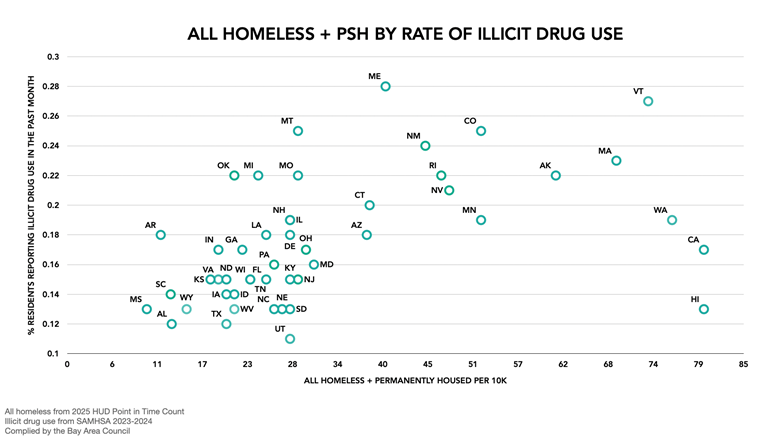
The link between drug use and homelessness. The role of addiction and homelessness is a hotly contested subject in homeless policy circles, with some saying the connection is obvious and others saying the connection is secondary to housing costs. The below chart plots each state’s 2025 per capita population of homeless individuals and formerly homeless individuals in permanent housing against that state’s rate of illicit drug use among residents older than age 12 within the past month. There’s a clear correlation between the prevalence of illicit substance use and the rate of homelessness, which supports the drug abuse theory. However, look at the outliers: California and Hawaii—places with high rates of homelessness and modest rates of illicit substance use that just so happen to have the highest housing burden in the U.S. (meaning median rents consume the highest percentage of median income), which supports the housing cost theory. I think the obvious answer is that both drug use and housing costs are causal factors and that they can interact with each other in a negative feedback loop where the presence of one exacerbates the other. Expensive housing can push even sober people onto the streets, where they’re much more likely to develop an addiction than they otherwise might have avoided had they remained housed. Note: the chart uses the permanently housed figures from 2024 since HUD hasn’t yet released that data by state for 2025.
Bay Area Council role. The Council’s homelessness committee has two priorities: expanding access to sober housing for homeless addicts seeking recovery, and ending unsheltered homelessness through the expansion of interim housing options and enforcement. On recovery, we’re currently co-sponsoring a bill, AB 1556 (Haney), with San Francisco Mayor Daniel Lurie that would significantly expand access to sober housing, which all but vanished following the loss of state funds when California adopted its Housing First law in 2015. Surveys show many homeless Californians struggling with addiction desperate want/need sober housing to support their recovery but none is available. That bill recently cleared the Assembly and is now in the Senate. On unsheltered homelessness, we’re focusing on this for three big reasons. First, unsheltered homelessness is (or should be) simply unacceptable from a public health and safety perspective. Unsheltered Californians suffer devastatingly high rates of infectious disease, chronic disease, trauma, and death both at the hands of the elements and criminal violence.
When people whose homelessness may have been brief instead find themselves in an encampment, they can endure trauma that makes their recovery far more difficult and costly to resolve. Second, these impacts have huge and unsustainable costs that undermine the delivery of other social services, from housing to transit to public safety.
Lastly, because we actually have the resources to scale low-cost interim housing. The Council sponsored SB 1395 (Becker) in 2022, which makes it much easier for local governments to scale interim housing, and this year we’re supporting legislation SCR 131 (Blakespear) to make it official state policy to end or prevent unsheltered homelessness specifically. Perhaps most importantly, we’re educating local policy makers on the benefits of interim housing one city council and county board of supervisors at a time.
For More Information Contact: